
This leaflet is for anyone who is recovering from arthroscopic (keyhole) hip surgery. It is designed to support and guide you through the early stages of your recovery.
What has the surgeon done?
During your hip arthroscopy procedure your surgeon would have made small incisions into the side of your hip. Most commonly this would have been in an attempt to repair some torn cartilage or shave a part of the bone to help reduce pain and improve function.
Recovery after surgery
Following your hip arthroscopy surgery it is important that you participate fully in your rehabilitation to help optimise your outcome. Your advice and exercises will depend on the consultant performing the procedure and to some extent what was actually performed during the procedure.
Goals of the initial rehabilitation phase:
The primary goal of this phase is to protect the surgery to ensure appropriate healing. Other goals include;
- Adequate pain control
- Normal walking pattern, with elbow crutches to begin with
- Commence early rehabilitation exercises and begin to move the hip within a comfortable range of motion.
Discomfort
Post-operative pain, swelling, and bruising are a normal part of the recovery process. The muscles and tissues surrounding the hip will also take time to heal. It is likely you will require some short term pain relief medication on a reducing basis over several weeks following the surgery. Crutch use, ice, activity pacing and rest may help.
Following your discharge from hospital; you may benefit from applying an ice pack three to four times daily for 15-20 minutes. You will be able to reduce the frequency after this time but will find that you will benefit from ice therapy for up to three months to help manage any pain.
If you have any concerns regarding managing your pain, please discuss this with your GP.
When to seek medical attention
We would advise you to seek urgent medical help if you experience any of the following after the procedure:
- Have a sudden increase in severe pain, swelling or tenderness in the thigh or calf which is getting worse and not just related to pain expected while performing the exercises.
- Have concerning pain, swelling or tenderness in the joint which is getting worse.
- Develop a high temperature and feel unwell.
- See fluid, pus or blood coming from the wounds.
- Develop new numbness or tingling near to the joint / down to the foot.
Walking and Walking aids
Most people undergoing a hip arthroscopy will need a period of time walking with elbow crutches after the procedure. You will either be, fully weight baring (FWB) or partial weight baring (PWB) depending on your consultant and the type of procedure you have had. A physiotherapist will provide you with walking aids and show you how to use them. They will also complete a stair/ step assessment as required.
Use crutches as instructed to allow you to put the correct amount of weight through your leg in the correct manner i.e. walking with the heel going down first, and also not walking on a bent knee.
You can then wean off the elbow crutches following the advice from the Physiotherapist / Consultant team.
Stairs / Steps with crutches
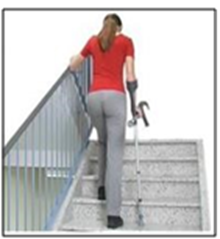
Going up stairs with a rail
Keep your crutch/es on the step you are standing on.
Step up with your un-operated leg, then your operated leg and then bring your crutch/es up onto the same step.
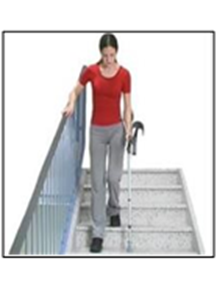
Going down stairs with a rail
Put your crutch/es down first into the middle of the step below Step down with your operated leg and then follow by your un-operated leg.
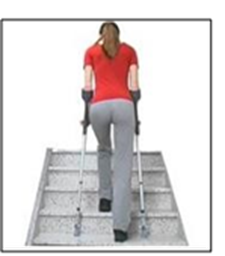
Going up stairs without a rail
Keep your crutches on the step you are standing on.
Step up with your un-operated leg, then your operated leg and then bring your crutches up onto the same step.
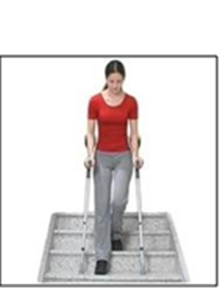
Going down stairs without a rail
Put your crutches down first into the middle of the step below Step down with your operated leg and then follow by your un-operated leg.
Physiotherapy
It is recommended that you attend outpatient physiotherapy after a hip arthroscopy procedure. A physiotherapist will complete this referral on discharge from hospital, but you can also find these contact details in this leaflet to contact if you have not heard anything.
Your rehabilitation can take 6-12 months in total depending on your goals and level of function you are aiming for.
If you are a registered patient of a Gateshead or Newcastle GP, the Tyneside Integrated Musculoskeletal Service (TIMS) will be your physiotherapy provider: https://www.tims.nhs.uk/ or 0191 445 2643
If you are a registered patient of Durham GP, the County Durham integrated MSK service will be your physiotherapy provider: https://patient.inhealthcare.co.uk/selfenrol/v2/form 01388 455 200
If you are an out of area resident (Registered to a GP out of Newcastle/Gateshead/Durham) the Queen Elizabeth Hospital physiotherapy team will be your provider. https://www.gatesheadhealth.nhs.uk/services/physiotherapy/musculoskeletal-physiotherapy-service/ 0191 445 2320
You will also be seen in orthopaedic clinic after your surgery, physiotherapy can also be requested then if necessary.
Follow up
You may have an appointment in the orthopaedic clinic 6-8 weeks after your procedure, however the follow up plan is different between each Consultant.
Exercises
It is important that you continue doing the exercises that have been given to you by the physiotherapist on being discharged. These exercises should be completed three to four times a day.
It is normal to experience additional discomfort whilst doing these exercises for up to an hour afterwards, but this should not last. Try taking your pain medication before exercising and using an ice pack afterwards.
Please see below for some exercises to start in the initial phase of your rehabilitation, whilst waiting to see your outpatient physiotherapist.
Phase 1 exercises
Try to do these exercises little and often in the first few weeks after your operation. Aim for 10 repetitions, 3-4 x day.
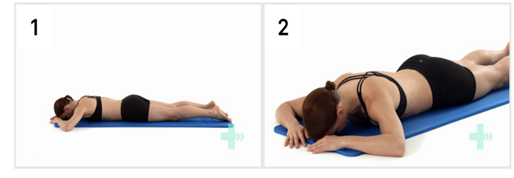
Lying on your front
Lie down on a mat or on your bed.
This will gently stretch your thighs, abdominal muscles and your upper back.
Place a pillow under your tummy if this is too much of a stretch.
Heel Slides
Lie on your back with your legs straight out in front of you.
Ensure you point your knees and toes directly up to the ceiling.
Slide one heel along the floor towards your buttock.
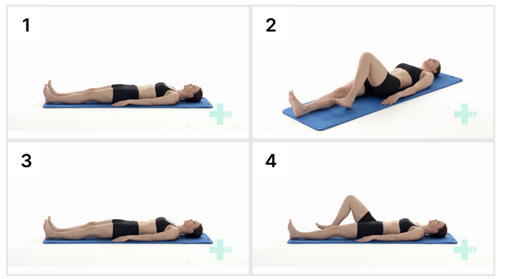
Only exercise within a comfortable range of motion.
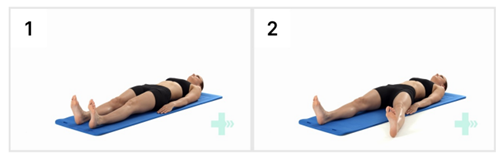
Hip abduction
Lie on your back with your legs straight and your toes pointing upwards.
Move your leg out to the side as far as you comfortably can and then bring it slowly back in to the start position. Only exercise within a comfortable range of motion.
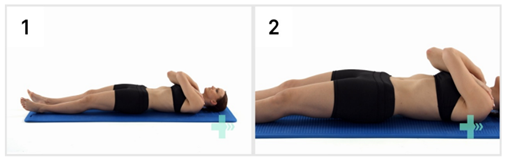
Glute squeeze
Lie on your back with your legs straight.
Clench your buttocks together and hold this position.
Hold for 5-10 seconds
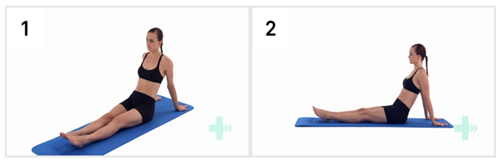
Thigh Squeeze
Sit upright and clench your thigh muscles, pushing the back of your knee into the bed so your leg straightens. Hold for 5-10 seconds.
Bridge
Lie on your back with your knees bent and your feet flat on the floor.
Tighten your buttock muscles and lift your hips up into the bridge position. Make sure you keep your hips up and level throughout the movement.

Work
Returning to work will be dependent on the demands of your job. This will be guided by your surgical team and physiotherapist. This will be sooner if you have a sedentary / desk based job. If you have a heavy manual job you may require longer off work. You can discuss this with your GP or Consultant if you are not sure.
Driving
If you have any restrictions you will not be able to drive for at least 6 weeks following your operation. Once your restrictions have been removed and you are able to walk without any mobility aids you can drive when you feel safe to do an emergency stop and safely control a car. You must tell your insurance company that you have had knee surgery. If in doubt, contact your consultant or GP.