
Occasionally sperm samples are produced that contain no sperm, this is called azoospermia. There are several different causes for this which include:
- An obstruction preventing sperm release, due to injury or infection.
- An absence of the tube called the vas deferens that brings the sperm from the testicle. Some men are born with this condition.
- A previous vasectomy.
- The testicles are producing such low numbers of sperm that they don’t reach the vas deferens; this is called non obstructive azoospermia.
In the first 3 causes, sperm are produced by the testicles but are unable to be ejaculated because of a blockage or absence of the vas. The man can still ejaculate seminal fluid, but this fluid will not contain any sperm. Sometimes it may be possible to remove the blockage in the vas, such as during a vasectomy reversal. However, it may not be possible to restore the sperm count to levels achieved before the vasectomy.
However, it may be possible to collect sperm from an area of the testicle called the epididymis; this is where the sperm are temporarily stored.
In cases of non-obstructive azoospermia very small amounts of sperm may be produced and can be collected directly form the testes. This is done by performing multiple testicular biopsies at random. Under these circumstances some of the biopsies may be sent to the pathology laboratory for further analysis to see if more can be found out about the sperm production issue.
In men with obstructive azoospermia there is a very high chance of recovering sperm by this method (>90%). In men with non-obstructive azoospermia the chance of recovering sperm is approximately 40%. Sperm that is collected in this way can be used in fertility treatments where the eggs collected are injected with a single sperm (ICSI). Pregnancy rates following this type of treatment are very similar to ICSI treatments using ejaculated sperm.
How is Surgical Sperm Retrieval (SSR) performed?
At Gateshead Fertility our route of surgical sperm retrieval is PESA (Percutaneous Epididymal Sperm Extraction).
This involves the passage of a fine needle through the skin covering the testis into the epididymis. This is where the sperm are stored after being formed in the testis.
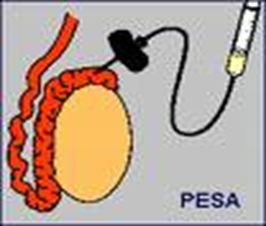
A PESA can usually be carried out under local anaesthetic but sometimes a sedation type of anaesthetic is also required. If sedation is required you may require up to 3 hours at the hospital.
The samples collected will be analysed by the embryologists and you will be advised on the same day about the quality of the sample and whether there are any sperm present. If sperm are present the sample will be frozen for use at a later date. During your IVF cycle the sperm will be thawed and ICSI will be used to inject a single sperm into each of the eggs collected that are suitable for injection. If SSR is successful there is usually enough sperm for several IVF treatments.
Are there any risks with SSR?
As with any surgical procedure, bleeding, infection, injury or anaesthetic risks are possible. In SSR however these complications are rare. You may experience some local pain and swelling but this usually settles within a week. Scarring and atrophy (shrinkage) of the testicle are very rare complications of the procedure.
What happens if no sperm is retrieved?
If during the procedure no sperm is retrieved, then you will be informed straight away, and the Consultant Urologist will discuss options with you.
It may be suggested that a testicular biopsy is arranged to retrieve sperm. If this is required, you will be referred onto Centre for life for a TESA as this is a procedure Gateshead Fertility do not offer.
The unit does not schedule any IVF/ICSI treatment until we know that there are sperm.
Contact Us
If you have any queries or concerns, please do not hesitate to contact us as there will always be someone happy to help.
Telephone: 0191 445 2768 (Direct Line)
Email: [email protected]