
This leaflet aims to help you understand and gain the maximum benefit from your operation. It is intended for patients who are either thinking about or have decided to have surgery after discussing this with their consultant or surgical team. Each person’s operation is individual and you may be given specific instructions that are not contained in this leaflet.
What is a SLAP tear?
Your shoulder is the most mobile joint in the body due to the configuration of the ball and socket joint. The socket (glenoid) is very shallow which allows it to be increasingly mobile. To compensate for this, it contains a thick rim of cartilage (labrum) which surrounds and helps to deepen the socket. Along with the rotator cuff muscles, ligaments (including the joint capsule) and the glenoid labrum, they all assist in keeping the shoulder stable through its normal range of movement.
A SLAP lesion/tear stands for Superior Labrum from Anterior to Posterior and refers to a specific area of change or tear within the labrum. The long head of biceps tendon also attaches to it at the top of the joint.
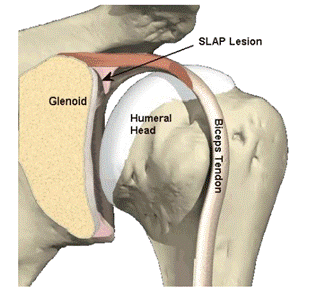
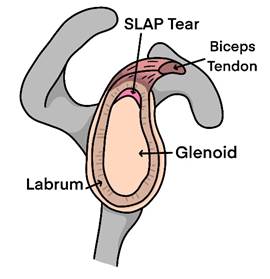
A SLAP tear usually occurs through trauma or repetitive overuse, such as:
- fall on to the outstretched hand
- shoulder dislocation
- road traffic accident
- catching a heavy object, forceful pull on the arm
- rapid or forceful movement of the arm when it is above shoulder height
- repetitive overhead sports or occupations; throwing athletes, weight lifters
- over time, changes to the labrum can occur slowly and it is seen as part of the normal ageing process. This is usually in those over the ages of 35-40 years and differs from an acute injury in a younger person.
What are the symptoms?
- pain is the most common complaint and often associated with overhead movement
- you may experience a sensation of locking, catching, grinding or popping in the shoulder
- inability to lie on the affected side
- reduced shoulder strength
- loss of movement in the shoulder
What are the treatment options available?
- Conservative management – for the vast majorityof SLAP lesion/injuries, the initial management is non-operative. Combination of rest, activity modification, analgesia and physiotherapy may help the symptoms. Often SLAP tears are part of the ageing process and do not need any treatment. Should non-operative treatments fail to improve your symptoms, then surgical options may be considered.
- Surgical management – if your shoulder continues to be painful despite conservative measures, then surgery may be considered to repair the tear. This will be discussed with you.
What is a SLAP repair?
The operation is to reattach the torn labrum back down to the shoulder socket. This is usually attached using small anchors with sutures.
It is usually done as an arthroscopic (keyhole) procedure; the surgeon uses a camera and instruments to perform the surgery. You will have 2-4 small scars, which are 5-7mm in length at the back, side and front of your shoulder.
If there are reasons why the procedure cannot be carried out arthroscopically, it can be done as an open procedure. This means cutting the skin at the front of the shoulder to get access to the shoulder tissues. This will leave a scar about 7cm in length along the front of the shoulder. You will likely have more pain after the operation with the open procedure. You might need additional procedures during the same sitting, which will be discussed by your surgeon/team member. Following surgery, you will have stitches over the wound and a dressing will be put on your shoulder to keep it dry and clean.
What are the aims of surgery?
The aim of a SLAP repair is to attach the damaged labrum (cartilage) to the glenoid (socket) of the shoulder to reduce your symptoms and restore stability.
Are there any complications with this operation?
The intended benefits of the operation are to improve pain, movement and function, although all surgical procedures are associated with a degree of risk. These are:
Common
- Pain levels felt after surgery vary for each individual. There is also the risk that you may not get full pain relief following your operation.
- Stiffness after shoulder surgery can occur. In most cases it improves with physiotherapy, but sometimes you may need additional intervention. Almost all stiffness has resolved by 1 year after surgery, although this does vary.
- Bleeding (<1%)during or after surgery. This can be mild.
- Further dislocation/instability – lifetime dislocation risk of 10-15%.
- Scarring – most surgical scars look a bit red following surgery but usually they become small and pale.
Unusual (less than 1 in 10)
- Infection of the wound is rare with arthroscopic surgery (<1%). After your operation, you should contact the surgeon’s team if you get a temperature, notice discharge from your wound, feel unwell, or if your wound becomes red, sore or painful.
- Failure to resolve symptoms.
- Minor altered sensation around wound sites.
Rare (less than 1 in 100)
- Failure of the repair / may need revision surgery – If the result is unsuccessful or the repair fails we may need to repeat the surgery.
- Persistent stiffness.
- Deep infection.
- Neuro vascular nerve injury is rare (< 1%). Numbness and paraesthesia (tingling) are the usual symptoms. Most nerve injuries usually resolve in time, however it may remain permanent
- Chronic regional pain syndrome (an abnormal reaction to surgery or trauma resulting in unexpected levels of pain, sensitivity, stiffness and swelling).
- Deep Vein Thrombosis (DVT) or Pulmonary Embolism (PE) these are uncommon.
- Anaesthetic complications which the anaesthetist will discuss with you.
What happens before the operation?
Pre-admission assessment
This is an assessment of your health to make sure you are prepared for your admission, treatment and discharge. Please bring a list of all your current medication including a list of allergies and the type of reactions. Before the date of your admission please, read very closely, the instructions given to you by the pre-admission assessment and your confirmation appointment letter.
Planning ahead
Once you have your date for surgery, you can do several things to aid preparation for your operation and to improve your recovery.
It is important to plan and arrange for how you will manage when home. Stocking up your freezer with easy cook items is advised (particularly if you live alone), as you may find daily tasks such as cooking more difficult initially after your operation. If you have family or friends who can stay with you or visit regularly, this may make your recovery easier both for helping with household tasks and moral support.
Smoking
Smoking is shown to delay wound healing and increase complications after surgery. Patients, who stop smoking benefit from long-term improvements to general health, decrease the risks associated with anaesthetic and have a better outcome from surgery. If you are interested in stopping smoking, please speak to your pre assessment nurse or GP for advice and services available.
Cancellation
If you are unable to attend your appointment, please contact us immediately so that we can offer your appointment to another patient.
Your Surgery
Anaesthetic
A SLAP repair is usually performed under a general anaesthetic, which puts you to sleep. However, you may be offered a regional anaesthetic (nerve block) which will numb the affected arm and will assist with pain control after the operation. It can take up to 24 hours before this completely wears off, during this time, you will not be able to move your arm and you may have some altered sensation of the arm or hand that persists for some weeks. The anaesthetist will see you before your operation and discuss your anaesthetic with you.
Day of surgery
You will be given specific instructions about when to stop eating and drinking, please follow these carefully as otherwise this may pose an anaesthetic risk and we may have to cancel your surgery. You should bath or shower before coming in to hospital.
The anaesthetist, surgeon or a member of the team will visit you and answer any questions you may have. You will be asked to sign a consent form.
A cuff will be put on your arm, some leads placed on your chest, and a clip attached to your finger. This will allow the anaesthetist to check your heart rate, blood pressure and oxygen levels during the operation. A needle will be put into the back of your hand to give you the drugs to send you to sleep. You may also receive an injection into the side of your neck (nerve block) to numb your shoulder and help with pain control after the operation.
Hospital stay
The SLAP repair is usually done as a day case procedure, however depending on your recovery after the operation and your home situation you may be required to stay overnight.
Recovery after surgery
After surgery, you will see a physiotherapist in the recovery room. They will give you advice around your surgery, wearing the sling and provide you with a post-surgical exercise leaflet. It is important you do these exercises regularly to prevent your shoulder from becoming stiff. Always be guided by your physiotherapist/surgeon as to when you can start to do things.
When do the stitches come out?
The stitches will be removed at your GP surgery or within an orthopaedic clinic, usually 10-14 days after your operation. Keep the wound dry until it is healed.
Pain
Significant pain and discomfort is common after surgery which especially in the first 6 weeks. You will be given appropriate painkillers on discharge from hospital. If you feel you are unable to manage your pain please discuss this with your GP, surgeon or physiotherapist.
Wearing a sling
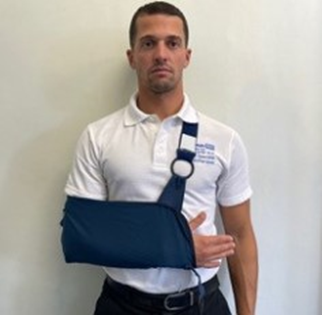
On return from theatre your shoulder will be in a sling to protect the repair during the healing period. You will be guided as to how long you need to wear the sling for by the physiotherapist/surgical team. You must not remove your sling except for washing, dressing and appropriate exercise. Ensure that your wrist and hand is correctly in the sling.
Sleeping
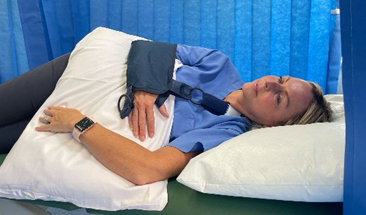
If provided with a sling, this must be worn in bed, for the duration that you are advised to wear the sling.
You should not lie on your operated shoulder or elbow for the first 6 weeks after surgery.
We would recommend that you lie on your back or on the non-operated side:
- If you are lying on your back,place a pillow under your upper arm / elbow to make it more comfortable.
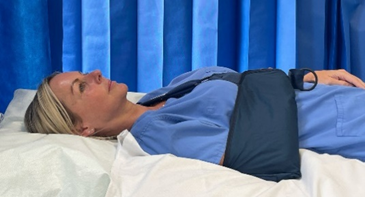
- If you are lying on your non-operated side, you can fold or hug a pillow in front of you to support the arm. You can also tuck a pillow along your back, to help prevent rolling onto the operated shoulder.
- Once the sling can be removed, you may still find it comfortable to continue sleeping in these positions.
Washing and dressing
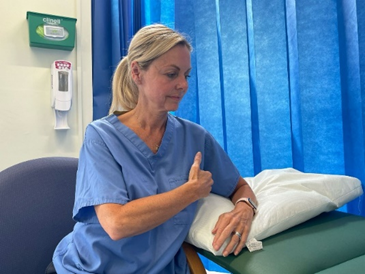
- Sitting down is usually best as you can support your arm on a pillow while it is out of the sling.
- You may find it easier wearing loose clothing with front fastenings. When getting dressed, dress your operated arm first and when undressing this arm comes out last.
Daily Activities
Although your labrum has been repaired, it takes time to heal. You will need to use your non-operated arm for activities like eating, dressing and cooking for the first 3-6 weeks. Even if you come out of your sling before 6 weeks you still need to protect the operated arm and avoid lifting or pushing up from a chair. Avoid lifting anything heavy for at least 3 months after surgery.
It is normal for you to feel discomfort, aching and stretching sensations when you start to use your arm. Intense and lasting pain (e.g. for 30 minutes) means that you should reduce that particular activity or exercise.
Physiotherapy
You will be referred to outpatient physiotherapy and an appointment will be sent out in the post. The physiotherapist will progress your exercises and assist in your recovery. Continuing the exercises at home will enable you to gain maximum benefit from your operation. This may continue for many months until both you and the physiotherapist are happy with your progress.
Please remember, individual patients will progress differently following surgery and this can be dependent upon the repair. Please be guided by your physiotherapist or surgical team with returning to activities.
If you have not received a physiotherapy appointment within 2 weeks of your operation, please contact the physiotherapy team on the number(s) below.
Physiotherapy locations
Please note, depending on the location of your GP, the physiotherapy provider may be different:
- If you have a Gateshead / Newcastle GP, your physiotherapy provider will be Tyneside Integrated Musculoskeletal Service (TIMS). If you have a query about your first appointment with TIMS, please contact the booking team on 0191 445 2643
- If you have a Durham GP, your physiotherapy care will come under Durham. Please contact the Queen Elizabeth hospital, physiotherapy department should you not receive your first appointment on 0191 445 2320
- If you have a GP that is outside of the Gateshead / Newcastle or Durham area and you have had elective surgery, your physiotherapy will be at the Queen Elizabeth hospital. If your surgery is due to trauma, your physiotherapy provider will be with the hospital affiliated to your GP practice. Should you not receive your first appointment, please contact physiotherapy reception on 0191 445 2320
Driving
We advise that you do not drive for at least 6 weeks after your operation. This is to protect the surgical repair. It is wise to discuss this with your insurance company before you return to driving.
Flying
Discuss with your consultant and with the airline’s medical department if you wish to fly within 6 weeks of your operation due to the risk of clot formation.
Your recovery
The recovery time after a SLAP repair is variable for each individual. Functional range of movement is usually achieved by 8-10 weeks. The improvements continue for up to 3 months post-surgery. From 6 months the improvements are slower but you will continue to improve up to 1 year post surgery.
Everybody is individual and progresses at different rates. Overall, majority of patients return to sport and full activity by 6 months post-surgery.
Return to work/sport
- Sedentary work ie: office work – as soon as you feel comfortable, usually around 3-4 weeks
- Heavy manual work – at least 3 months. Discuss with surgeon.
- Sports – your return to your sport or leisure activities should be discussed on an individual basis with your surgeon or physiotherapist. You should not return to any type of contact sport for at least 3 months. Please discuss with your surgeon prior to doing this.
Telephone numbers
| During the hours of 8am – 8pm contact the Day Surgery Unit, Peter Smith Surgery Centre, Queen Elizabeth Hospital | 0191 445 3009 |
| During the hours of 8pm – 8am contact Level 3, Peter Smith Surgery Centre, Queen Elizabeth Hospital | 0191 445 2028 |
| During the hours of 0800 – 1630 contact the Physiotherapy Department | 0191 445 2320 |
| During the hours of 8am – 8pm. If you have a Gateshead or Newcastle GP, TIMS will be your physiotherapy provider If you have a query about your first appointment with TIMS please contact our booking team on 0191 445 2643 If you are a current TIMS patient and have a query about your follow-up appointment please contact our local admin team on 0191 213 8800 | Booking Team: 0191 445 2643 Local Admin Team: 0191 213 8800 https://www.tims.nhs.uk/ |
| Main Switchboard | 0191 482 0000 |