
This leaflet aims to help you understand and gain the maximum benefit from your operation. It is intended for patients who are either thinking about or have decided to have surgery after discussing this with their consultant or surgical team. Each person’s operation is individual and you may be given specific instructions that are not contained in this leaflet.
What is the rotator cuff?
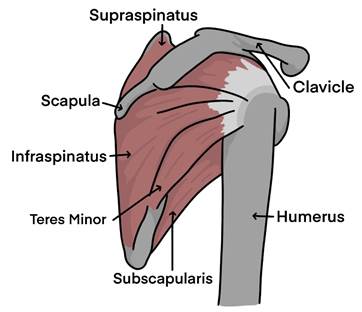
Your shoulder is a ball and socket joint, it is the most mobile joint in the body. It depends on strong muscles and ligaments to move and stabilise it. The rotator cuff are a group of four muscles that work together to keep the shoulder joint in the correct position and also control shoulder movements. They originate from the shoulder blade and their tendons form a hood, covering the ball of the shoulder joint.
The four rotator cuff muscles are individually called subscapularis, supraspinatus, infraspinatus and teres minor.
How does a tear develop?
The tear usually occurs in the tendon, in the area where the muscle joins the head of humerus (bone of the ball of the shoulder joint).
Rotator cuff tears can occur in a number of ways:
- Injury
- Overuse
- Gradual weakening over time
- As we get older, rotator cuff tendon tears are commonly seen on ultrasound scans in those individuals without having an injury. They are usually a result of the normal ageing process and can be treated successfully with physiotherapy and pain management approaches.
What are the symptoms?
- If associated with an injury, you may present with a weak and painful shoulder with reduced movement. In some cases, you may have a sudden inability to raise or rotate the arm after the incident, although you may be able to raise the arm if it is assisted.
- Pain is often worse on movement and whilst in bed sleeping on the affected side. Pain is typically over the side of the arm and radiates to the elbow.
- Occasionally you may feel pins and needles in the hand.
- Stiffness can happen in long-standing rotator cuff tears, this usually means that full movement may not be achieved after treatment.
What are the treatment options?
The treatment options for managing a painful shoulder are:
- Pain killers are commonly advised, your pharmacist or GP can discuss this with you.
- Leaving it alone – a rotator cuff tendon tear will not heal on its own and it may gradually increase in size. We are unable to predict if your pain will improve or get worse if it is left alone. However, Physiotherapy can help the intact tendons to compensate for the torn one. It can also help to improve movement and build muscle strength which aids recovery and function.
- Steroid Injections are discussed on an individual basis and maybe offered to patients when pain is the main symptom. Often adequate pain relief is sufficient to maintain good function. Injection treatment may be advised because the patient is not fit for surgery or if the tear is considered irreparable. Pain relief is usually temporary and this does differ patient to patient.
- Surgery is sometimes recommended to improve pain and function. This is more so in patients who suffer a tear after an injury and in those where the above measures have failed.
The aim of surgery is to restore shoulder function as closely as possible to how it was before the injury and to improve pain. While it is often perceived as a quick and easy fix, in reality, there is a long period of post-operative physiotherapy and certain risks are associated with the procedure. You might need additional procedures during the operation, which will be discussed by your surgeon or a team member.
Surgical procedure
The purpose of the operation is to repair the rotator cuff to improve your pain and function. Surgery is usually performed as a keyhole procedure (arthroscopic) although depending on the type of tear and surgeon preference, this may be done as a small open incision making a scar over the front of your shoulder. With a keyhole procedure this involves making 2 to 5 small scars around the shoulder.
The surgery involves stitching the torn tendon back to the arm bone. You might need additional procedures during the same sitting which will be discussed by your surgeon/team member. These may include the following:
- Debridement (clean up) of tendons or tendon repair
- Capsular release – this can help to improve the underlying stiffness and movement of the shoulder.
- Tendon release being a biceps tenotomy. This is cutting off the long head of biceps tendon which is a common procedure. This will change the appearance of your upper arm muscle in that the biceps will sit lower called a ‘popeye’ sign.
- In some cases, the rotator cuff tear is too big and or too fragile for the repair to be possible and only a partial repair may be achieved.
Are there any complications with this operation?
The intended benefits of the operation is to improve pain and function, although all surgical procedures are associated with a degree of risk. The main complications are:
- Pain levels felt after surgery vary for each individual depending upon pain thresholds, the nature of the problem and various other factors. It can be common to have significant pain for the first 6 weeks following surgery and through the night. There is also the risk that you may not get full pain relief following your operation.
- Stiffness after shoulder surgery can occur. It is important to follow your physiotherapy post-surgical instructions regarding exercise. In most cases it improves with physiotherapy, but sometimes you may need additional intervention. Almost all stiffness has resolved by 1 year after the operation, although this does vary.
- Infection of the wound is rare with arthroscopic surgery (<1%). After your operation, you should contact the surgeon if you get a temperature, notice discharge from your wound, feel unwell, or if your wound becomes red, sore or painful.
- Bleeding (<1%)during or after surgery.
- Failure to heal/re-tear this is more common with large tears, if you are a smoker or if you are aged over 65 years. It may also occur if you don’t fully comply with your post-operative instructions regarding exercise and using the sling.
- Revision (repeat) surgery can give less favourable outcomes when compared to primary surgery.
- Neuro vascular nerve injury is rare (< 1%). Numbness and paraesthesia (tingling) are the usual symptoms. Most nerve injuries usually resolve in time, however permanent nerve damage may occur.
- Unsightly scarring – most surgical scars look a bit red following surgery but usually they have disappeared to a thin pale line by 1 year.
- Anchor failure this is uncommon.
- Deep Vein Thrombosis (DVT) or Pulmonary Embolism (PE). A DVT is a blood clot in the leg and the clot can spread to the lungs (PE) and make you unwell. These are uncommon.
- Anaesthetic complications which the anaesthetist will discuss this with you.
What happens before the operation?
Pre-admission assessment
This is an assessment of your health to make sure you are fully prepared for your admission, treatment and discharge. Please bring a list of all your current medication including a list of allergies and the type of reactions. Before the date of your admission please, read very closely, the instructions given to you by the pre-admission assessment and your confirmation appointment letter.
Planning ahead
Once you have your date for surgery, you can do several things to aid preparation for your operation and to improve your recovery. It is important to plan and arrange for how you will manage when home. Stocking up your freezer with easy cook items is advised (particularly if you live alone), as you may find daily tasks such as cooking more difficult initially after your operation. If you have family or friends, who can stay with you or visit regularly, this may make your recovery easier both for helping with household tasks and moral support.
Smoking
Smoking has been shown to delay wound healing and increase complications after surgery. Patients, who stop smoking benefit from long-term improvements to general health, decrease the risks associated with anaesthetic and may have a better outcome from the operation. If you are interested in stopping smoking, please speak to your pre assessment nurse or GP for advice and services available.
Weight
Even though you may feel fit and healthy at your current weight, patients with a higher body mass index are most likely to experience potential serious complications both during and after surgery. If you are keen to lose weight, please speak to your GP or pre assessment nurse for services available.
Cancellation
If you are unable to attend your appointment, please contact us immediately so that we can offer your appointment to another patient.
Your surgery
Anaesthetic
A rotator cuff repair is usually performed under a regional anaesthetic (nerve block) with or without a general anaesthetic (which puts you to sleep). A regional anaesthetic will numb the affected arm and will assist with pain control after the operation. It can take up to 24 hours before this completely wears off, during this time, you will not be able to move your arm and you may have some altered sensation of the arm or hand that persists for some weeks. The anaesthetist will see you before your operation and discuss your anaesthetic with you.
Day of surgery
You will be given specific instructions about when to stop eating and drinking, please follow these carefully as otherwise, this may pose an anaesthetic risk and we may have to cancel your surgery. You should bath or shower before coming in to hospital.
The anaesthetist, surgeon or a member of the team will visit you prior to the operation, and can answer any questions. You will be asked to sign a consent form.
Prior to and during the operation, a blood pressure cuff is placed on your arm, some leads placed on your chest and a clip attached to your finger. This will allow the anaesthetist to check your heart rate, blood pressure and oxygen levels during the operation. You might just receive an injection into the side of your neck (nerve block) to numb your shoulder; you will remain awake during the procedure. If you have a general anaesthetic, a needle will be put into the back of your hand to administer the drugs to send you to sleep.
Hospital stay
Rotator cuff repair is usually done as a day case procedure, however depending on your recovery after the operation and your home situation you may be required to stay overnight.
Recovery after surgery
After surgery, you will see a physiotherapist in the recovery room. They will give you advice around your surgery, wearing the sling and provide you with a post-surgical exercise leaflet. It is important you do these exercises regularly to prevent your shoulder from becoming stiff.
When do the sutures come out?
The sutures will be removed at your GP surgery, usually 10-14 days after your operation. Keep the wound dry until it is fully healed.
Pain
Significant pain and discomfort is common after surgery especially in the first 6 weeks. You will be given appropriate painkillers on discharge from hospital. If you feel you are unable to manage your pain please discuss this with your GP, surgeon or physiotherapist.
Wearing a sling
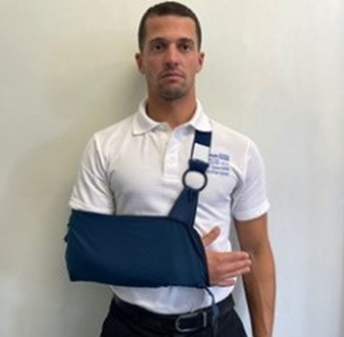
On return from theatre, your shoulder will be in a sling to protect the tendon during the healing period. The sling will need to be worn for up to 6 weeks, however your physiotherapist/surgical team will guide you on this.
You must not remove your sling except for washing, dressing and appropriate exercise. Ensure that your wrist and hand is correctly in the sling.
Sleeping
If provided with a sling, this must be worn in bed, for the duration that you are advised to wear the sling.
You should not lie on your operated shoulder or elbow for the first six weeks after surgery.
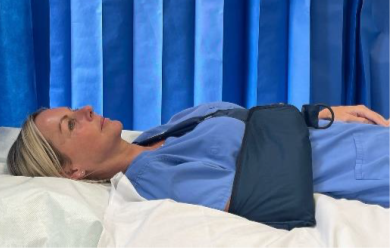
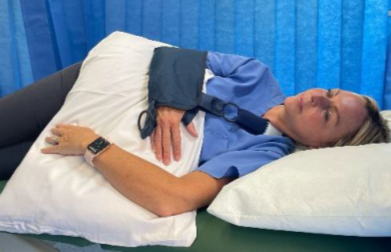
We would recommend that you lie on your back or on the non-operated side:
- If you are lying on your back, place a pillow under your upper arm / elbow to make it more comfortable.
- If you are lying on your non-operated side, you can fold or hug a pillow in front of you to support the arm. You can also tuck a pillow along your back, to help prevent rolling onto the operated shoulder.
- Once the sling can be removed, you may still find it comfortable to continue sleeping in these positions.
Washing and dressing
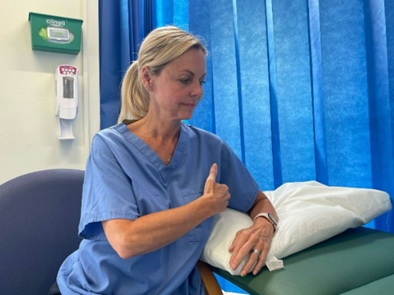
Getting washed and dressed needs to be done carefully. Sitting down is usually best as you can support your arm on a pillow while it is out of the sling.
You may find it easier wearing loose clothing with front fastenings. When getting dressed, dress your operated arm first and when getting undressed, this arm comes out last.
Daily Activities
Although your tendon has been repaired, it takes time to heal and then strengthen. You will need to use your non-operated arm for activities like eating, dressing and cooking for the first 6 weeks. Even if you come out of your sling before 6 weeks, you still need to protect the operated arm and avoid lifting or pushing up from a chair.
We would advise you that you do not reach behind your back for the first 6 weeks. After 6 weeks you can use your operated arm for light tasks but avoid any activities involving weight (ie: lifting a kettle, pan or iron) for at least 3 months after surgery. It is normal for you to feel discomfort, aching and stretching sensations when you start to use your arm. Intense and lasting pain (e.g. for 30 minutes) means that you should reduce that particular activity or exercise.
Physiotherapy
You will be referred to out-patient physiotherapy and an appointment will be sent out in the post. The physiotherapist will progress your exercises and assist in your recovery. Continuing the exercises at home will enable you to gain maximum benefit from your operation. This may continue for many months until both you and the physiotherapist are happy with your progress.
Please remember, individual patients will progress differently following surgery and this can be dependent upon the repair. Please be guided by your physiotherapist or surgical team with returning to activities.
If you have not received a physiotherapy appointment within 2 weeks of your operation, please contact the physiotherapy team on the number(s) below.
Physiotherapy locations
Please note, depending on the location of your GP, the physiotherapy provider may be different:
- If you have a Gateshead / Newcastle GP, your physiotherapy provider will be Tyneside Integrated Musculoskeletal Service (TIMS). If you have a query about your first appointment with TIMS, please contact the booking team on 0191 445 2643
- If you have a Durham GP, your physiotherapy care will come under Durham. Please contact the Queen Elizabeth hospital, physiotherapy department should you not receive your first appointment on 0191 445 2320
- If you have a GP that is outside of the Gateshead / Newcastle or Durham area and you have had elective surgery, your physiotherapy will be at the Queen Elizabeth hospital. If your surgery is due to trauma, your physiotherapy provider will be with the hospital affiliated to your GP practice. Should you not receive your first appointment, please contact physiotherapy reception on 0191 445 2320
Driving
We advise that you do not drive for at least 8 weeks after your operation. This is to protect the surgical repair. It is wise to discuss this with your insurance company before you return to driving.
Flying
Discuss with your consultant and with the airline’s medical department if you wish to fly within 6 weeks of your operation due to the risk of clot formation.
Your recovery
The recovery time after a rotator cuff repair is variable for each individual. However, after six months there will be a significant improvement and after the full nine months rehabilitation period we would hope to see a significant reduction in pain and a good level of function.
Below is the estimated progress you should be making following your arthroscopic surgery, although individuals do vary: (If you had open surgery, your estimated progress will be slightly slower).
• 4 weeks: more than 50% of movement restored with assistance
• 6 weeks: full movement restored with assistance
• 12 weeks: full active movement restored
Functional activities (these are minimum times and could be longer)
| Return to Work | Light duties Manual job | from 6 weeks 12 to 16 weeks (guided by surgeon) |
| Swimming | Breaststroke Freestyle | From 8 to 12 weeks (guided by your surgeon/physio) 12 to 16 weeks |
| Golf | 12 to 16 weeks | |
| Lifting | 12 to 16 weeks (guided by your individual strength) | |
| Gardening (strenuous) | 12 to 16 weeks | |
| Specific Sport | be guided by your physiotherapist/surgeon – there is no guarantee you will be able to return to your pre injury level of activity |
Telephone numbers
| During the hours of 8am – 8pm contact the Day Surgery Unit, Peter Smith Surgery Centre, Queen Elizabeth Hospital | 0191 445 3009 |
| During the hours of 8pm – 8am contact Level 3, Peter Smith Surgery Centre, Queen Elizabeth Hospital | 0191 445 2028 |
| During the hours of 0800 – 1630 contact the Physiotherapy Department | 0191 445 2320 |
| During the hours of 8am – 8pm. If you have a Gateshead or Newcastle GP, TIMS will be your physiotherapy provider If you have a query about your first appointment with TIMS please contact our booking team on 0191 445 2643 If you are a current TIMS patient and have a query about your follow-up appointment please contact our local admin team on 0191 213 8800 | Booking Team: 0191 445 2643 Local Admin Team: 0191 213 8800 https://www.tims.nhs.uk/ |
| Main Switchboard | 0191 482 0000 |