
This information leaflet is to help you understand more about an Indwelling Pleural Catheter and what having one inserted will mean.
What is an Indwelling Pleural Catheter?
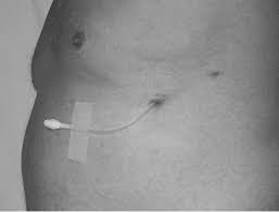
An indwelling pleural catheter (IPC) is a small tube designed to drain fluid from around your lungs easily and painlessly, whenever it is needed. The tube is soft and flexible. One end remains inside the chest and the other passes out through the skin. There is a one-way valve on the end that prevents fluid leaking out of the tube and air entering into the chest.
Why do you need an IPC?
The pleural space surrounds the lungs and usually contains a small amount of fluid. In your case more fluid has collected making it difficult for the lung to expand, this makes you short of breath.
What are the alternatives?
There are several alternatives to an IPC which will be discussed with you prior to insertion. They include: managing your breathlessness by the use of drugs such as oxygen or morphine, further aspiration of pleural fluid with a needle and syringe, or possibly an admission to hospital for a chest drain. While repeated procedures are possible, this is uncomfortable, carries risks and requires repeated trips to hospital.
How is the IPC put in?
The procedure will take place on the Respiratory ward (ward 9). You will meet with the doctor and nurse before the procedure and have an opportunity to ask any questions and go through the consent form.
You will then be asked to lie in a comfortable position. An ultrasound scan of the side of your chest will be performed to establish a suitable position for the drain, this is completely painless. We will then clean your skin thoroughly with an antiseptic to minimise the risk of infection. Then a local anaesthetic is injected into the skin to numb the place where the tube will go. This can sting a little but resolves quickly.
The doctor will then make two small cuts in the numb area of skin and gently open a path for the IPC. One cut is for the IPC to pass through the skin and the second is for it to be passed into the chest. The IPC is then eased into the chest.
We will put in two stitches when your tube is inserted. One is removed after 7–10 days and the second after a few weeks. This can be done by the practice nurse at your GP surgery.
Will it be painful?
Local anaesthetic is injected into the skin to prevent you feeling pain while the drain goes in. You may feel a pushing or tugging sensation, but it should not be painful. At the end of the procedure the area around the drain may feel ‘bruised’ or ‘sore’ for about a week but this can be controlled with painkilling medication.
How long does it take?
The procedure takes 20-40 minutes, but you may be on the ward for a few hours. You are welcome to bring your own reading or listening material. Most people can go home the same day.
What are the risks?
In most cases, the insertion of an IPC and its use in treatment is a routine and safe procedure. However, like all medical procedures, they can cause some problems.
- Most people get some pain or discomfort from their IPC in the first week. We will provide you with painkilling medication to control this.
- Sometimes, IPC’s can become infected, but this is uncommon (affecting about 1 in 50 patients). Your doctor will thoroughly clean the area before putting in a chest drain to try and prevent this and we will teach you how to keep your catheter clean. Tell your doctor or nurse if you feel feverish or notice any increasing pain or redness around the chest drain.
- Occasionally, drains become blocked. If it stops draining we may be able to flush and unblock the drain, but occasionally we will need to remove it completely.
- Very rarely, the insertion may cause accidental damage to a blood vessel or other organ and cause serious bleeding. This only affects around 1 in 500 patients. Unfortunately, if it does happen it is a serious problem which may require an operation to stop it.
- If a cancer is the cause of the fluid collecting around your lung, then sometimes the cancer can affect the area around the IPC. Please let your doctors know if you develop a lump, or any pain, around the site. If this problem does develop your doctor will advise you on appropriate treatment.
If you notice any of these problems after the IPC is inserted, then you can tell the district nurse who will be responsible for the care of your drain in the community or contact your nurse specialist who can arrange for a review.
What if I take blood thinning tablets/injections?
If you take clopidogrel/Plavix, aspirin, warfarin or one of the new blood thinning tablets such as rivaroxaban or apixaban please tell your doctor who will discuss a personalised plan for these prior to the procedure.
How long does the drain stay in position?
Indwelling catheters are designed to be permanent. There is a soft cuff around the tube which is positioned under the skin to which the skin heals making the drain more secure. However, in some people the fluid dries up and they can be removed if they are no longer needed.
Who will drain the fluid from my IPC?
Drainage of the fluid is a straightforward procedure. There are a number of ways this can be done. The nurse specialist or ward nurses will be able to teach you, and/or a relative or a friend, how to drain the fluid so that it can be done in the comfort of your own home. You will be given illustrated instructions on how to do this which clearly takes you through the procedure step by step. Alternatively, we can arrange for a district nurse to do this for you at home.
How often does the fluid need to be drained?
When your catheter is inserted the doctor will remove some of the fluid from your chest cavity at the same time. This varies between people; some patients need daily drainage whilst others require only weekly drainage or less.
You can drain fluid as often or as frequently as is needed but you will be guided by your nurse or doctor.
Can I wash and shower normally?
Initially after insertion there will be a dressing placed on the catheter and we advise you to keep this dry until the stiches are removed. Providing the site is then clean and dry, you will be able to bathe or shower normally.