
Your consultant has recommended that you have a flexible sigmoidoscopy to view the left side of your large bowel.
What is a Flexible Sigmoidoscopy?
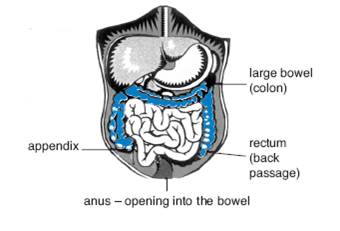
The examination is performed using a long flexible instrument (endoscope), about the thickness of your index finger, with a bright light at one end. The endoscope is advanced into the rectum, which is the lower end of the large bowel (colon), so we can look at the bowel lining. This will help discover the cause of your symptoms.
During the procedure, a small pinch of tissue (biopsy) or polyp may be taken. The tissue is removed painlessly by using tiny forceps which are passed through the endoscope.
What are the risks?
As with all medical procedures there are risks involved. The main risk of this procedure is a leak (perforation) through the bowel wall which occurs about once in every 1500 but may be higher if it is necessary to treat polyps (growths in the colon) If this occurs, an operation to repair the leak may be performed. Other complications include bleeding ( risk 1 in 150), bleeding can occur when removing polyps or biopsy sites although this is rare if this did occur a blood transfusion may be required.
Other rare complications include reactions to medications, sticking plasters and latex gloves. In addition it may not always be possible to complete the procedure. This may be due to the shape of your bowel or because you have asked us to stop or withdrawn your consent to the procedure.
You should be aware no test is 100% accurate and abnormalities may be missed, including cancers. You may wish to discuss this with the doctor/nurse who will seek your consent prior to the examination.
What should you do before the test?
If you are taking Warfarin or Clopidogrel or diabetic medication please contact the Endoscopy department prior to your procedure if this has not already been discussed with the nurse at your pre-assessment appointment.
Please stop the following medication 7 days prior to your procedure:
- Iron tablets/ liquid
No dietary changes are required for this examination. You may eat and drink and take your medication as normal.
To have a successful examination of your bowel you must ensure that your bowel is empty and clean. If the bowel is not cleared of bowel motion, it would be impossible to see all of it adequately. This would mean the test would have to be repeated.
A small enema is provided with this leaflet. This is a small bottle of fluid which is inserted via a small tube into your anus. Please ensure you have read through this information thoroughly before using the enema.
Enemas are safe, gentle and surprisingly easy to use. Most people find it convenient and comfortable to use the enema at home.
When to use the enema
- Around 2 hours before leaving the house for the test
- You should use the enema even if you have had your bowels open.
When not to use the enema
Do not use the enema if you are having treatment for kidney disease, colitis or have bloody diarrhoea – if in doubt ring the Endoscopy department and speak to a nurse.
Before using the enema
- Make sure you are near a toilet
- Find somewhere comfortable to lie down
- Have a towel to lie on in case of a little leakage.
How to use the enema
- The enema may be given at room temperature or warmed in warm water (not hot)
- Remove the cap from the nozzle
- Lie on your left side on the towel with your knees drawn up
- Insert the nozzle (3 inches, up to the disc) into the anus (back passage)
- Squirt in all the contents, remove the nozzle from your anus and stay lying down
- Try to hold the liquid inside for approximately 5-10 minutes but do not worry if you cannot hold it that long
- Go to the toilet but do not worry if you do not pass a motion at first
- Stay near a toilet for the next hour
- Some people may experience mild stomach cramps for a short while
- Some people may feel a little dizzy. If this should occur, then we advise you lie down until this feeling passes
- The effects of the enema will then stop and you should have no problems travelling to the Endoscopy department.
If you experience any difficulties whilst giving the enema, stop immediately and contact the Endoscopy department.
On the day of the test
On arrival in the endoscopy department please give your name to the receptionist. The appointment time is the booking in time, not your procedure time however, we will try to commence your procedure as soon as possible.
Prior to the test, you will be seen by a nurse who will go through the health questionnaire with you. A doctor/nurse will speak to you in a private area of the department, before your procedure. This will give you the opportunity to ask any questions. You will then be asked to sign a consent form, indicating you understand the nature and risks of the procedure. Before the test, you will be asked to change into a hospital gown.
Family members are welcome to wait in reception but are not permitted within the clinical areas.
Once in the procedure room the nurses and doctors will do all they can to make you feel comfortable. A monitor will be attached to your finger to record your pulse rate and level of oxygen
You will be asked to lie on your left side. The examination will take approximately 10 to 15 minutes and may result in some mild discomfort. This occurs as the endoscope is introduced and the bowel is inflated with air.
After the test
After the examination you are free to go home as soon as any follow-up arrangements have been made. You may feel a little bloated but this will soon settle.
How will you know the results of the test?
The doctor or nurse endoscopist performing the procedure will often be able to give you some results after the procedure. Before you are discharged you will be given clear details concerning any follow up arrangements.
A full report will be sent to your GP and/or hospital Consultant.
When will I find out the results?
You will be given most of your results on the day. Only biopsy results take approx. 14 days and you can get those results either from your GP or at your follow-up appointment.
Frequently asked questions:
Does it hurt and will I be in much pain?
The examination may result in some abdominal discomfort due to the bowel being inflated with air. This discomfort should begin to settle once the procedure is finished.
Who will be in the procedure room whilst I am having the test?
The doctor and two to three nursing staff are always present during the procedure. There is also the possibility of medical or nursing students observing and you will be asked for your permission to allow the observers in whilst you have the procedure.
Please do not bring valuables or jewellery to the Unit with you as the Trust cannot accept responsibility for any loss of your personal belongings.
Contact Numbers
If you have any further questions, you should contact the following:
Accident and Emergency Department 0191 445 2171
NHS Direct 111
If you require ambulance transport please contact your GP surgery.
Endoscopy Unit
Endoscopy Department
Queen Elizabeth Hospital
Sheriff Hill
Gateshead
Tyne and Wear
NE9 6SX
 Monday – Friday
–
Monday – Friday
–

Enter by the Outpatients Entrance and follow signposts for Endoscopy.